Design partner program open

One room per risk. Both firms in it. A record neither can edit.

Where a wholesale broker and their carrier markets place a complex risk together — one slip, layer by layer, submission through binder to mid-term endorsement. An assistant on each side drafts and reviews; neither can approve, bind or send. That is enforced in the database, not the interface.

  • Your submissions never train a model
  • Governance enforced in the database, not the interface
  • SOC 2 Type II planned before general availability

One term, start to finish: drafted, approved by a person, recorded.

20
negotiated fields on the shared slip

Limits, sublimits, retro dates, territory, subjectivities — the things a real ACORD actually carries.

3
independent mechanisms between a draft and an approval

A trigger, a missing privilege, and a gated function. Remove any one and the other two still refuse.

0
ways to edit the audit trail, ours included

Append-only at the database. Our own administrative credentials are refused alongside everyone else’s.

1
link for an underwriter to join a placement

No account to buy, no rollout, no procurement conversation on the market side.

  • Coastal property
  • Heavy construction
  • Excess casualty
  • Cyber & tech E&O
  • Professional lines
  • Environmental
  • Product recall
  • Marine & energy
  • Habitational
  • Vacant & distressed
  • Manuscript endorsements

The problem

$136 billion in E&S premium is negotiated over email.

Complex commercial placements — coastal property, heavy construction, cyber, professional lines — cannot be underwritten from a template. Every term, every endorsement, every exclusion is negotiated between a broker and an underwriter. Today that negotiation happens across fragmented email chains, PDF redlines and Word documents. There is no shared workspace, and no complete record of what was agreed. The industry now wants to add AI on top of that.

Fragmented negotiation

A single placement can run across parallel threads, attachments and side conversations. Terms settled in one thread do not reliably survive into the binder, and the gap between what was agreed and what was documented is where E&O exposure lives.

No shared source of truth

When compliance asks who agreed to an endorsement and when, the answer is spread across separate inboxes at two different firms — some belonging to people who have since left.

The AI trust gap

Compliance teams are holding generic AI tools out of underwriting workflows, and they are right to. A model that can draft a term and also commit to it is a model that can commit the carrier to something nobody approved.

What we heard

From conversations with people who place and underwrite this business. Their words, kept anonymous.

I almost quit my job because of this.
Placement team, wholesale broker
Everything was just a big mess.
Underwriting operations
I was losing my mind.
Producer, specialty lines
No one could remember the terms.
Broker, excess casualty

Slipstream

One workspace. Every decision. A record neither side controls.

Both firms work the same placement in the same room. The assistants read the submission, draft manuscript language and raise what an underwriter would want resolved before quoting. Every proposal and every decision lands on an append-only trail, and every finalization requires a person on the side it belongs to.

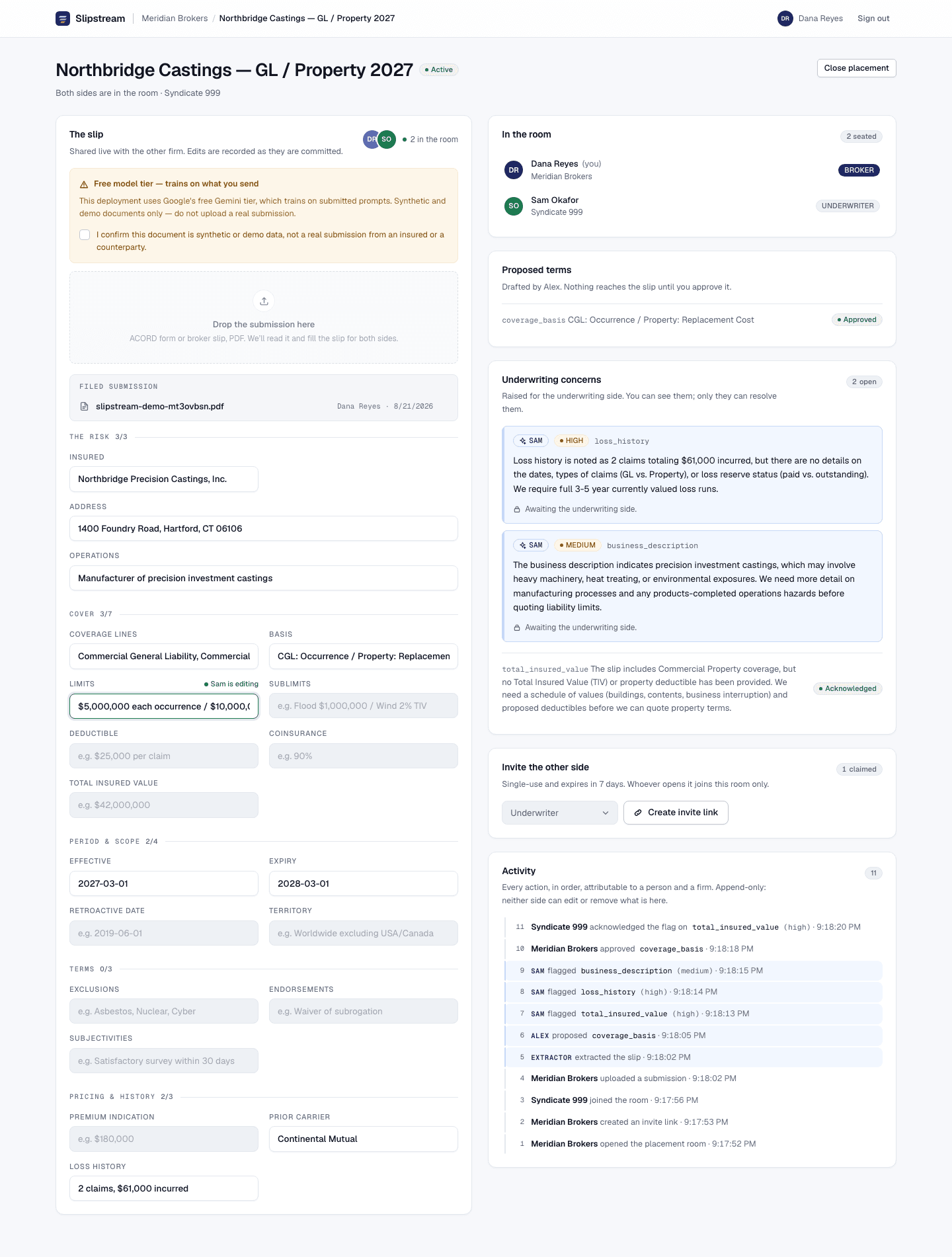
slipstream.page/rooms

A Slipstream placement room: the shared slip with twenty negotiated fields on the left, and on the right the room roster, terms proposed by the broker-side assistant awaiting approval, underwriting concerns raised by the market-side assistant, and the ordered audit trail.
An actual placement room, on a sample submission. Real extraction, real assistant output, real approvals through the production gates.

Scoped to the placement, not the tenant

Access is granted per room. Every table is guarded by a policy that checks membership of that specific placement, so a firm sees the rooms it was invited to and nothing else — enforced in the database, not by a filter in the application.

An assistant on each side

The broking side drafts terms the submission supports. The market side raises what it would want resolved before quoting. Neither can agree anything, and neither can act for the other firm.

A trail that cannot be edited

Every state change is written to an append-only log with a hash chain, including changes attempted with administrative credentials. What was agreed, by whom, and when, in order.

Where this sits

Three things this is next to, and is not.

Software for this market has been built three ways. Each solves a real problem, and none of them is this one — so the distinction is worth a minute here rather than an hour of yours.

Not

An underwriting workbench

Intake, triage, appetite, portfolio steering — built for the inside of one carrier and genuinely good at it. But a placement is an argument between two firms, and the workbench stops at the edge of the first one. The part that falls back to email is the part that crosses the boundary.

Not

An AI brokerage

The newer bet is to take the commission and the client and replace the broker with agents. Slipstream does neither. The broker runs the placement and keeps the relationship; this is where they run it. We are infrastructure for the desk, not a competitor to it.

Not

A London-market placing platform

The e-placing systems digitise the Market Reform Contract for Lloyd’s business, and they digitise it well. US wholesale E&S is manuscript rather than MRC-shaped, and none of those platforms was built to answer what an assistant is permitted to do inside a live negotiation.

What is left is the thing Slipstream is: a negotiation held between two firms, with an assistant on each side, on a record neither of them can edit.

Governance architecture

Trust through architecture, not through promises.

Most AI safety in insurance is procedural: policies, reviews, training. Slipstream’s is architectural. The assistants are prevented from finalizing a term by three independent database-level mechanisms. Remove any one and the other two still hold. All three are asserted against a real Postgres instance on every test run, so a change that quietly weakened one would fail the build rather than ship.

An assistant

asks for a term to be approved

Held at proposed

A person

in the firm the term was drafted for

Approved
01
Insert trigger
02
No update grant
03
Gated function
Same track, same three mechanisms. The assistant is refused at the first one and never reaches the others.

Mechanism 01 — Trigger

A proposal is born pending, whatever it asks for.

A BEFORE INSERT trigger overwrites the status of every proposed term, and blanks the decision columns, before the row is stored. An assistant can ask for a term to arrive approved. The database writes it as pending anyway — the request never reaches the table as submitted.

slip_proposals — insert trigger
create function slip_proposals_force_pending()
returns trigger language plpgsql as $$
begin
  new.status     := 'proposed';
  new.decided_by := null;
  new.decided_at := null;
  return new;
end;
$$;

-- Fires on every insert, from every caller, including
-- the service role the assistants run as.
Mechanism 02 — Permissions

Nobody holds the grant.

No role has UPDATE on the proposals table — not the assistants, not a signed-in user, not an administrator. The only tables a signed-in session may modify in place are profiles and uploaded documents. This is not a runtime check that code could skip; without the privilege the statement is refused before it runs.

grants — what a session may write
revoke all on slip_proposals from anon, authenticated;

grant select, insert on slip_proposals to authenticated;

-- Deliberately absent: update, delete.
-- Asserted on every test run, against real Postgres.

Mechanism 03 — Gated function

One way out, and it checks who you are.

Because there is no UPDATE grant, a singleSECURITY DEFINER function is the only path out of pending. It refuses an unauthenticated caller, and it refuses anyone outside the organization the term was drafted for — so a counterparty cannot approve on your behalf, and an automated session cannot approve at all.

decide_slip_proposal — the only exit
if v_uid is null then
  raise exception 'not authenticated';
end if;

if v_org <> v_prop.proposer_org_id then
  raise exception
    'only a member of the proposing organization '
    'can decide this proposal';
end if;

-- Writes the decision and its audit row in one
-- transaction. There is no other way to leave
-- 'proposed'.

We cannot bypass this either. The mechanisms sit in the database, beneath the application, and they refuse our own administrative credentials. There is no founder override and no support tool that quietly writes the column. That is the point of putting them there.

Read the full governance documentation

The shape of the business

A programme is a tower. A policy is a year.

Most software built for this market models a placement as one limit, one market and one moment. Real business of any size is a tower of layers with several markets on each, over-placed and signed back to fit — and then it runs for twelve months and changes throughout. Slipstream is built for both halves.

$50m programme

Attachment reads bottom-up

$25m xs $25m

Third excess · 1 market

60% placed

$15m xs $10m

Second excess · 2 markets

Complete

$5m xs $5m

First excess · 1 market

Complete

$5m primary

Primary · 3 markets · 160% written

Signed down

A market may be signed down and never up, and an order that would take a layer past 100% of signed lines is refused — counting orders still outstanding, not only those already bound. A layer completes at 100% and releases the markets still being talked to on that layer. The programme is bound when every rung is.

A line is a share of a layer

Two figures, never one: the written line the market put on its quote, and the signed line the broker sets when the order goes in. A signed-down premium is pro-rated, because the rate was agreed and only the share changed — a book that keeps reporting the quoted figure after everyone was cut back overstates what is on risk by exactly the amount signed away.

The record does not stop at the binder

A placement takes three weeks and the policy runs for fifty. An endorsement is asked for by the broking side, issued by the market, and never edited — a correction is a further endorsement and a dropped request is withdrawn, so a market that spent an afternoon on a change can still find the record of having been asked.

The record can leave

One self-contained HTML file: every term, quote, condition and document, with a SHA-256 computed at export rather than read from a value written at upload, the full trail, and the integrity chain checked at that moment. It opens in any browser with no network and survives this product not existing, which is the actual requirement for an E&O file read years later.

And the desk has its own numbers

Hit rate, time to bind, premium on risk, counterparty responsiveness, and a queue of what has stopped moving — read from the same rows, scoped seat by seat like everything else. A rate with no denominator reads as an em dash rather than zero, and premium is never summed across currencies.

Inside the room

Every screen behind the claims above.

Rendered from the product’s own components with sample placement data — the same code a broker sees, not a mock-up. Names and figures are fixtures; everything else is the product as it runs today.

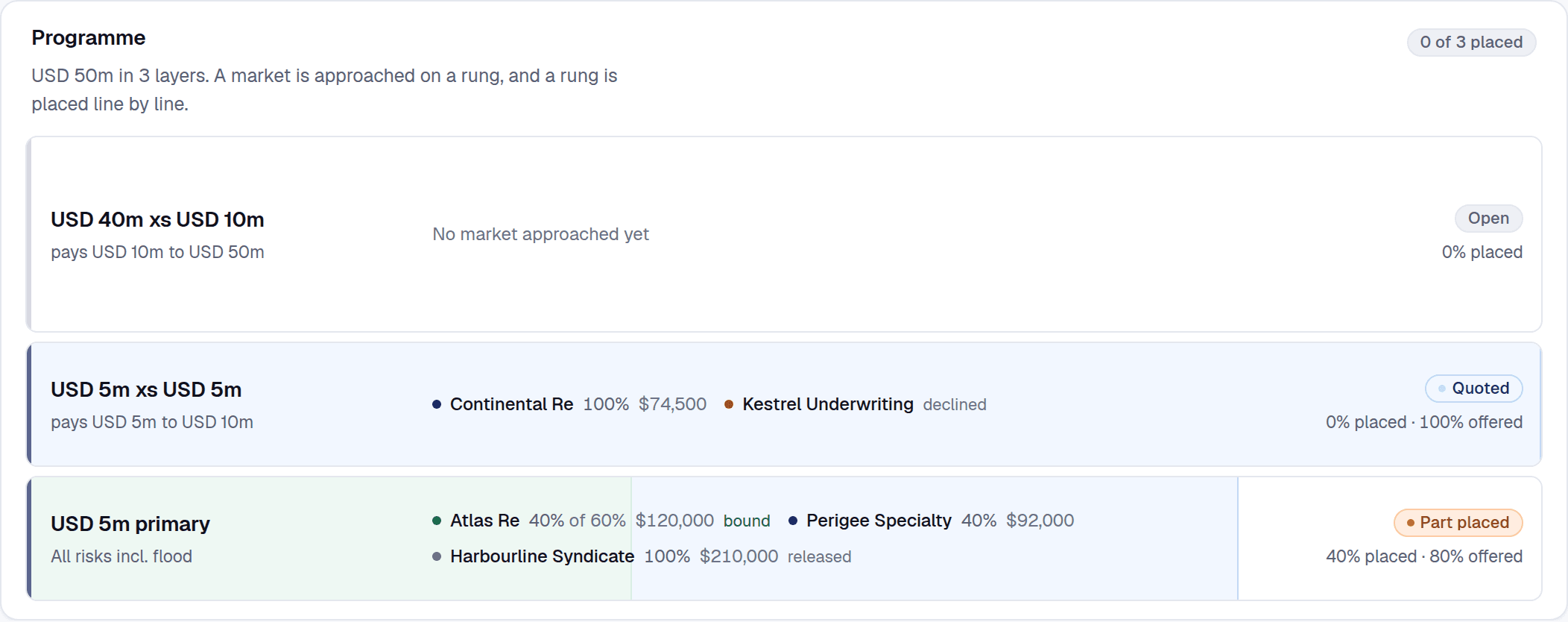
A layered programme drawn as a tower: a primary layer offered at 160% and signed back to 100%, with a first excess layer above it and the markets on each rung named.

A programme is a tower

Rungs carry attachment and limit; a market is approached on a rung and quotes a share of it. Over-placed and signed down, the way a shared layer is actually filled.

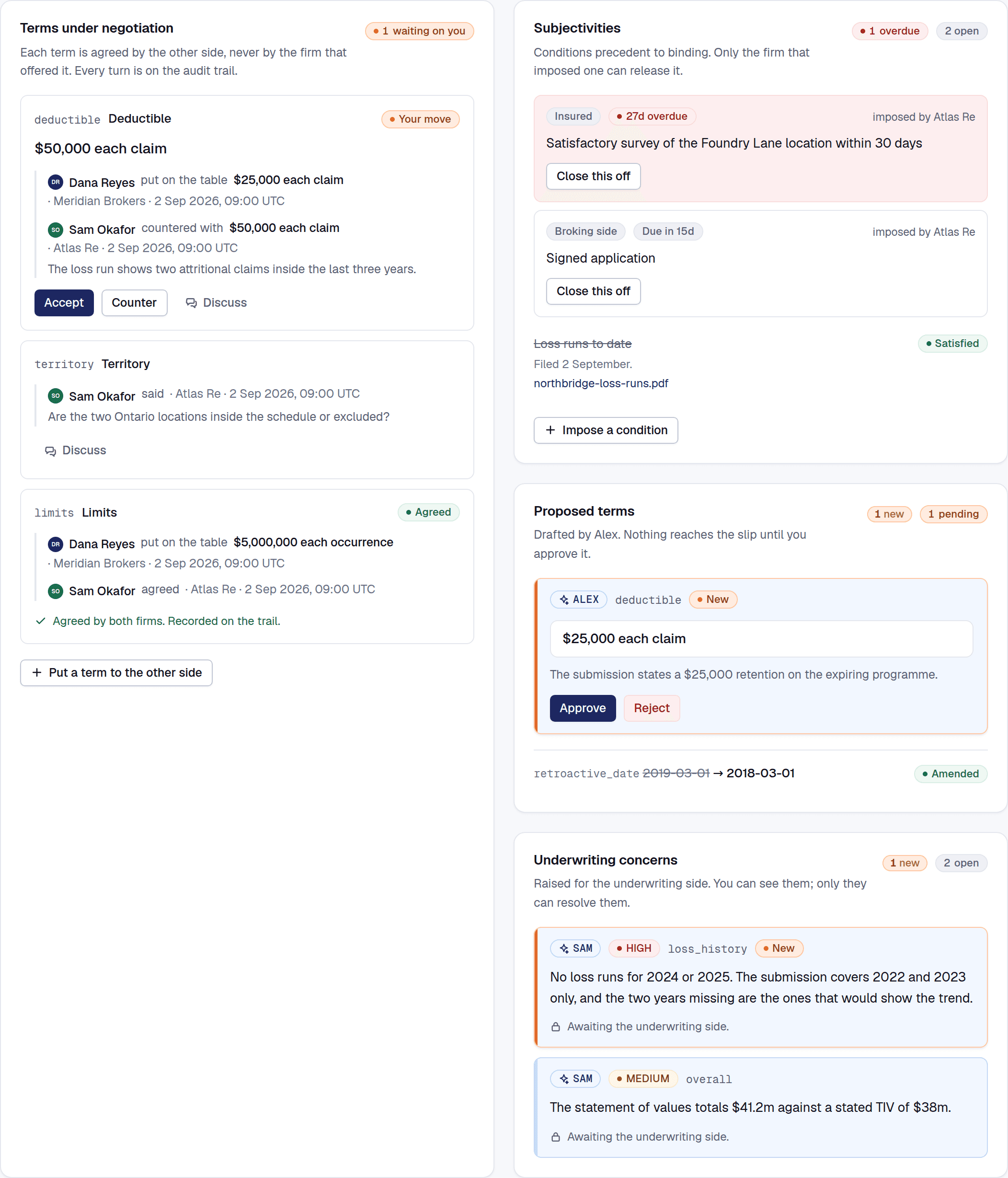
The negotiation tab: a term thread with a proposal, a counter and an acceptance by the other firm, and the conditions precedent to binding with who imposed each and when it is due.

A term is a thread

Proposed, countered, agreed — and a firm cannot accept its own number. A condition is released only by the firm that imposed it, citing the document that released it.

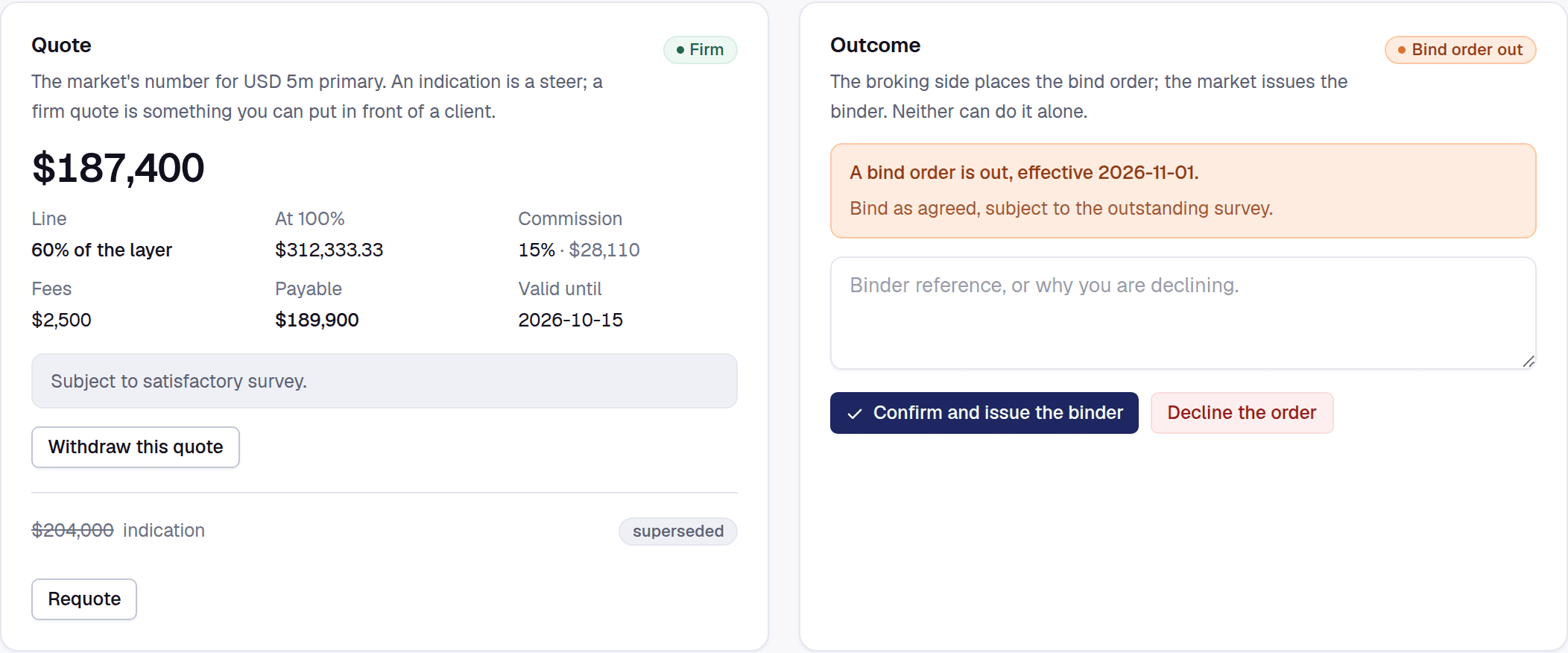
The market tab: an indication superseded by a firm quote with its line on the layer, a bind order sent by the broking side, and the binder issued by the market.

What the market is actually asking for

An indication, a firm quote, a bind order and the binder. A requote supersedes rather than edits, so the broker sees that a market moved, not only where it landed.

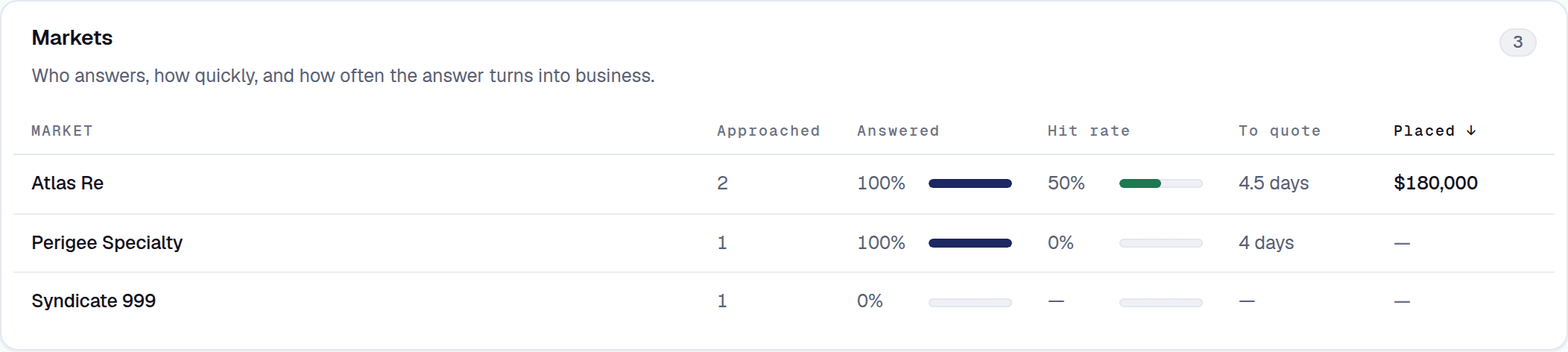
The book’s counterparty table: each market approached, how many submissions it answered, its median time to respond, and its hit rate.

The desk has its own numbers

Who answers, how quickly, and how often the answer turns into business. A rate with no denominator is shown as none, never as zero.

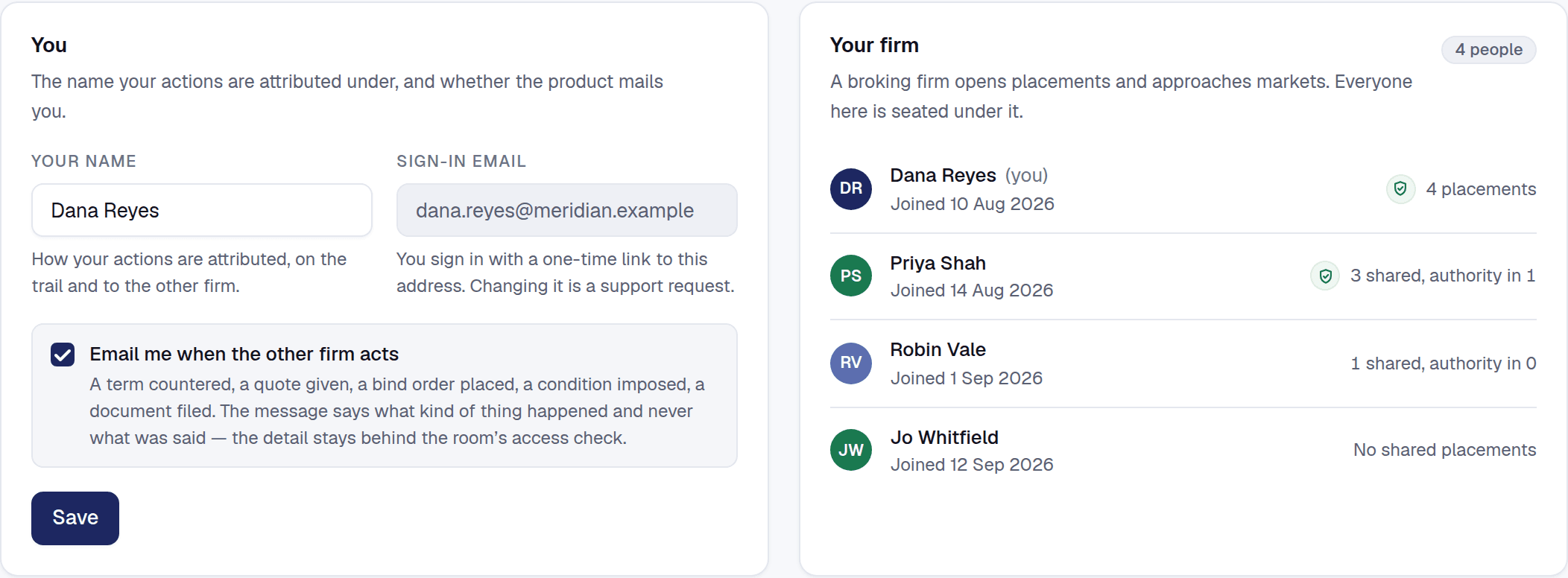
The settings page: a person’s name and notification preference on the left, and on the right the firm roster with each colleague’s shared placements and where they hold binding authority.

Who is at your firm, and who may commit it

Binding authority is delegated per placement and marked on the roster. Colleagues join by invitation; nobody becomes a firm by typing its name.

Built for

Built for the side that runs the placement.

The broker or MGA opens the room and controls it. Everyone else is there by invitation.

Wholesale brokers

You are running several markets against one risk, and the terms are moving in all of them at once. Slipstream keeps each placement in a single room, with the current state of the slip visible to everyone who should see it and to nobody who should not. The audit trail is a by-product of doing the work rather than something reconstructed from inboxes afterwards.

MGAs and program administrators

You are drafting under delegated authority, which means the line between assisted drafting and a decision that commits capacity has to be legible to your carrier partners. That line is the product: the assistants draft, and the binding decision is a human action recorded against a named person and firm.

And works with

Your carrier markets — no account to buy, nothing to roll out

An underwriter joins a placement from a link you send, sees that placement and nothing else, and needs no procurement conversation to take part. Their side gets the same assistant and the same governance: it raises what they would want resolved before quoting, and it cannot resolve anything on their behalf. If they later want rooms of their own, that is a separate conversation — it is not a condition of working with you here.

Design partner program

We’re taking on a small number of design partners.

Slipstream is pre-launch. We are looking for a handful of wholesale brokers, MGAs and carriers willing to run one placement through it and tell us where it breaks.

  • No cost during the pilot
  • Your submissions are never used to train a model
  • Weekly working sessions with the founders
  • Direct influence over what gets built next
  • Founding partner terms preserved at general availability

Ask about a pilot

A few questions, about two minutes. A founder reads and replies to every one — including the ones we are not the right fit for, where we will say so.

Open the request form

Where your submissions go, stated plainly rather than buried. A model reads every document you file — that is what extraction and drafting are. Slipstream sends them to Anthropic’s API on a paid workspace, whose terms do not use submitted prompts or completions to train models. Which provider and model read a given submission is written onto that submission’s own audit row, so the answer sits in the placement’s record rather than in a policy page you have to take on trust.

The founders

Why we’re building this.

Every insurtech is racing to build AI that makes underwriting decisions. We think that is the wrong problem.

The industry does not need faster underwriters. It needs the back-and-forth between brokers and underwriters to stop happening in email, and it needs a way to use AI in that process that a compliance team can actually approve.

Slipstream is the workspace, and the governance model that makes the workspace approvable.

We think the insurtech that wins this cycle will not be the one with the most autonomous AI. It will be the one that gives a regulated industry a way to adopt AI without inheriting its liabilities.

— The Slipstream team

Run one placement through it.

Six to eight weeks, no cost, weekly sessions with the founders. Bring a real or historical submission and tell us where it breaks.